Saint of the Month: July 2026, Moses the Strong
Hello, Redeemer!
As you know, each month we lift up a saint commemorated that month to name in our Eucharistic prayer. Each month, there are many saints we could choose from! We are moving through a very diverse three-year cycle of saints. Some aspects of that diversity are obvious and often discussed here in Lexington, like race/ethnicity, heritage or nationality, and gender. However, there is also a diversity in (dis)ability, time period, and vocation. Any time we are tempted to wonder, How could I, in this time and place, in this body and position in society–how could I ever be like a saint? we have only to look around us at the great cloud of witnesses. Their nobility and devotion show us how any life can be transformed by God. To use the language we use in Atrium 2, I have a blank page to fill out in the great unfolding of the kingdom of God.
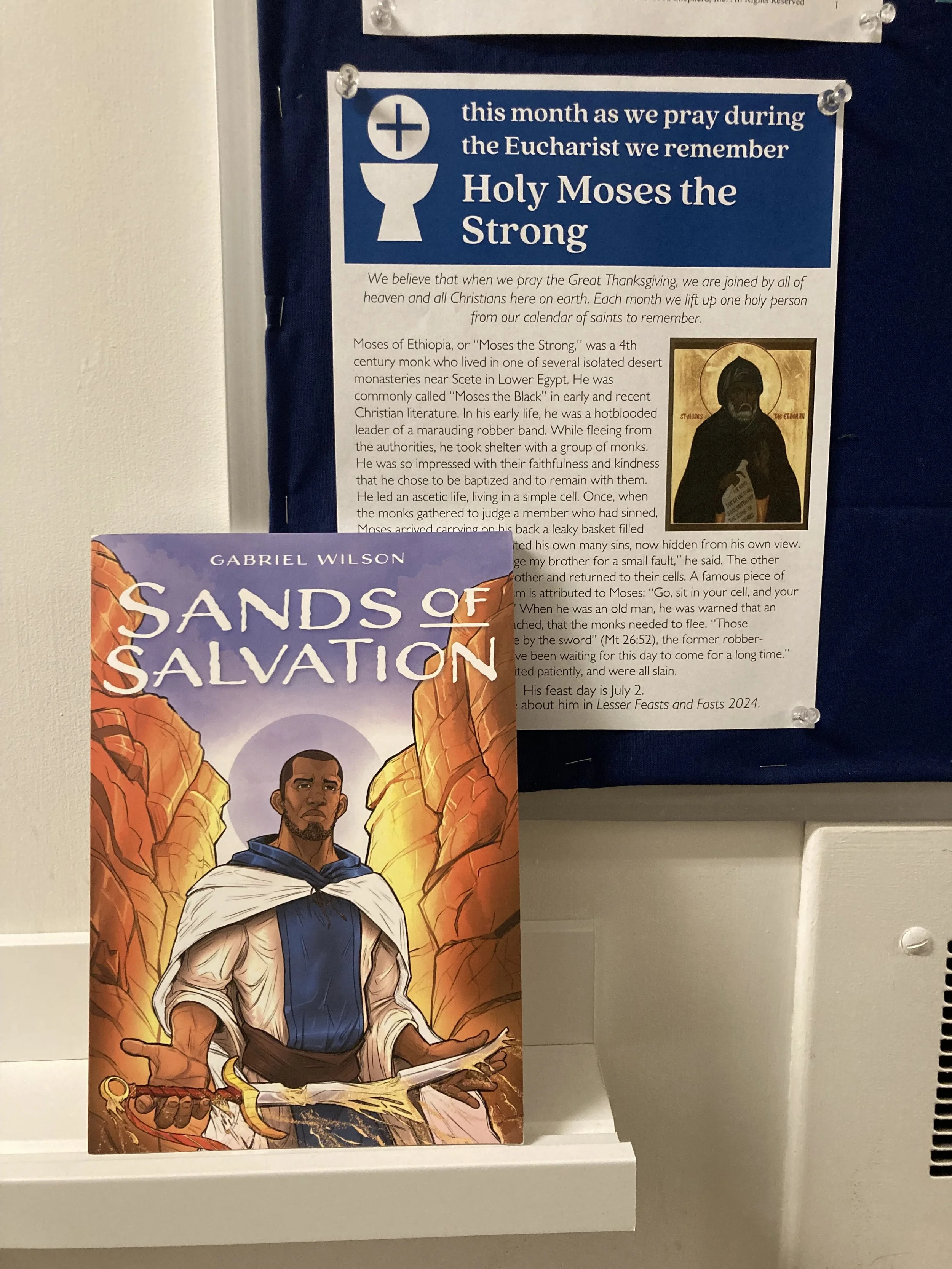
This month, our saint is “Moses the Strong,” also called “Moses the Ethiopian” or “Moses the Black.” While I had certainly heard of him before, the first time I was deeply moved by his story was when I read this graphic novel, Sands of Salvation, written for teens. (I have set out my copy by my office if you’d like to take a look!)
Here below is the shortened biography found on our posters in church. If you’d like to read the full biographical note, you can find it in the official Episcopal text, Lesser Feasts and Fasts 2024. That book is available online here as a pdf and is also our own little Handley Library reference shelf.
I hope you will join me this month in reflecting on the witness of Saint Moses the Strong!
Mtr. Emily
Moses of Ethiopia, or “Moses the Strong,” was a 4th century monk who lived in one of several isolated desert monasteries near Scete in Lower Egypt. He was commonly called “Moses the Black” in early and recent Christian literature. In his early life, he was a hotblooded leader of a marauding robber band. While fleeing from the authorities, he took shelter with a group of monks. He was so impressed with their faithfulness and kindness that he chose to be baptized and to remain with them. He led an ascetic life, living in a simple cell. Once, when the monks gathered to judge a member who had sinned, Moses arrived carrying on his back a leaky basket filled with sand. He said it represented his own many sins, now hidden from his own view. “And now I have come to judge my brother for a small fault,” he said. The other monks forgave their erring brother and returned to their cells. A famous piece of advice from desert monasticism is attributed to Moses: “Go, sit in your cell, and your cell will teach you everything.” When he was an old man, he was warned that an armed band of raiders approached, that the monks needed to flee. “Those who live by the sword shall die by the sword” (Mt 26:52), the former robber-murderer calmly replied. “I have been waiting for this day to come for a long time.” He and six other brothers waited patiently, and were all slain.